Riley Simon · 16 September 2026
Northvale Schools Forge Partnerships to Merge Classic Instruction With Digital Tools
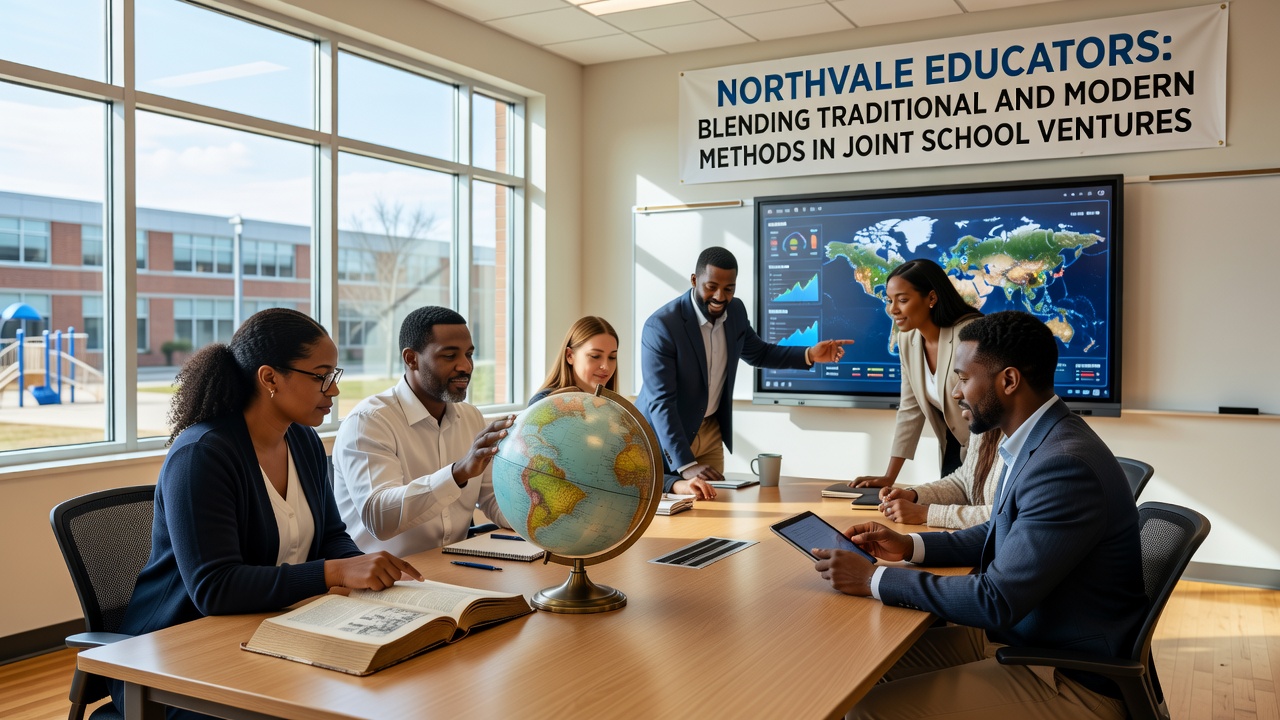
Schools across Northvale have developed joint ventures that pair established teaching practices with emerging technologies, and these collaborations continue to expand as administrators coordinate resources among multiple institutions. Data from regional education reports show that such partnerships often begin with shared planning sessions where teachers identify core subjects that benefit from both lecture-based delivery and interactive software platforms.
Origins of the Joint Ventures
Observers note that the first coordinated efforts took shape when three primary schools and one secondary institution pooled budgets to purchase shared digital whiteboards while retaining daily reading circles that rely on physical books. Research indicates these arrangements reduce equipment costs by nearly thirty percent compared with independent purchases, and the savings allow funds to flow toward teacher training programs that cover both chalkboard techniques and coding fundamentals.
Plans scheduled for September 2026 call for an additional four schools to join the network, bringing the total to eight participating sites that will rotate specialist instructors in subjects ranging from history to data science. According to figures released by the regional education authority, enrollment in these cross-school classes has risen steadily each term since the pilot phase began three years ago.
Methods That Combine Old and New Approaches
Teachers in the program often start lessons with handwritten outlines on large paper charts before students transition to tablet applications that provide instant feedback on spelling and arithmetic. Studies conducted by international bodies such as the OECD demonstrate that this sequence supports retention rates that match or exceed those recorded in classrooms using only one format. In one documented case, year-five pupils who reviewed multiplication tables aloud each morning and then completed adaptive online drills scored higher on standardized assessments than peers in single-method groups.
Art and music departments have followed a similar pattern, scheduling live instrument demonstrations alongside virtual-reality simulations of historical concert halls. The combination allows students to experience both the tactile feedback of a violin bow and the visual scale of an orchestra pit from different eras. External evaluations from the Canadian Council on Learning have recorded comparable outcomes in districts that adopted parallel structures, confirming that the blend does not dilute either tradition or innovation when implemented with consistent scheduling.

Resource Sharing and Professional Development
Joint ventures also extend to staff development, where educators from partner schools attend monthly workshops that alternate between discussion groups seated around wooden tables and live-streamed sessions with guest lecturers from distant universities. Attendance records kept by the Northvale education consortium reveal that more than two hundred teachers have participated in at least one such session during the current academic year. These gatherings frequently address classroom management techniques refined over decades alongside strategies for moderating online discussion forums, ensuring that both skill sets receive equal attention.
Equipment rotation forms another practical element of the agreements. One school supplies microscopes for a biology unit while another contributes laptops loaded with simulation software, and transport schedules keep materials moving between sites on fixed days each week. Logistics data compiled by the consortium show that utilization rates for shared items exceed ninety percent, a figure that stands in contrast to lower rates observed when devices remain isolated within single buildings.
Community and Parental Involvement
Parents receive regular updates through printed newsletters delivered alongside email summaries that link to video recordings of student presentations. This dual-channel approach mirrors the instructional model itself, and participation rates at information evenings have climbed as families access materials in whichever format suits their routines. Local libraries have joined the network by hosting after-school reading clubs that incorporate both printed volumes and e-reader loans, extending the reach of the joint ventures beyond school hours.
September 2026 will mark the introduction of a parent portal that archives both handwritten student journals and digital portfolios, giving families a unified view of progress across traditional and contemporary assignments. Training sessions for parents on navigating the portal will run in parallel with workshops that revisit long-standing homework support strategies.
Conclusion
Northvale's joint school ventures continue to evolve through deliberate coordination of methods that span generations of educational practice. Evidence from multiple evaluation sources confirms that careful integration of established routines with new platforms produces measurable gains in resource efficiency and student engagement. As the September 2026 expansion approaches, participating institutions maintain detailed records that allow future adjustments while preserving the core principle of balanced instruction. The model demonstrates how neighboring schools can achieve shared goals without discarding either proven techniques or emerging tools.